-
How does aikido work?
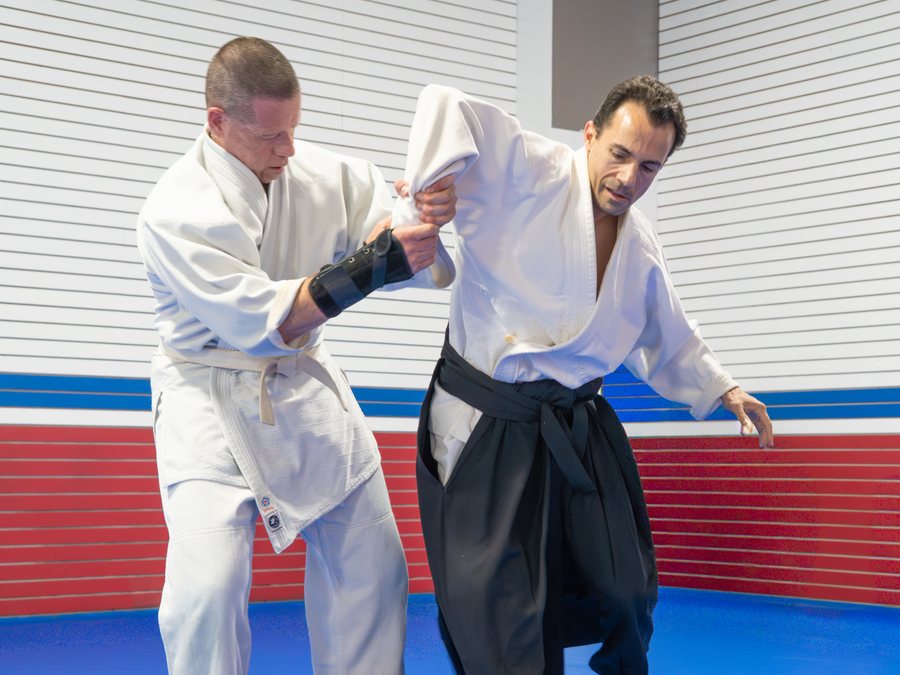
Aikido techniques focus on freeing yourself from grips, throwing an opponent to the ground by exerting pressure on the limbs, and immobilizing opponents by placing pressure on joints. Some techniques are spectacular, sending an opponent flying through the air. Others are small, deft movements that immobilize the aggressor. Ultimately, the energy of the attack is what brings down the attacker. Increased stamina, flexibility and muscle development occur naturally from training, but aikido techniques do not depend on strength for effectiveness.
-
Is aikido practical for self-defense?
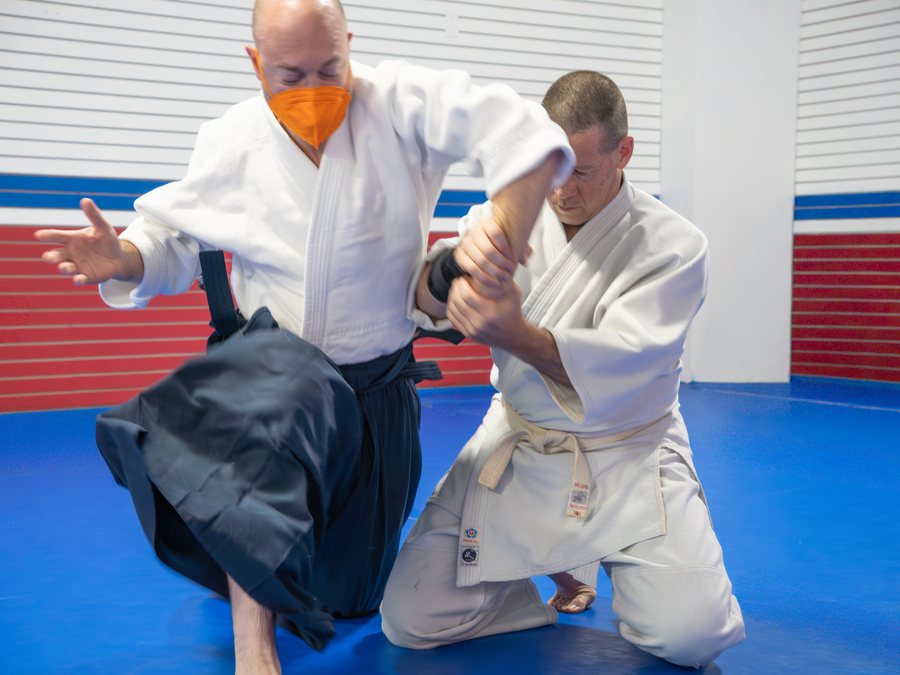
Yes. Aikido is a defensive martial art. Training teaches you how to defend yourself against strikes coming from various angles and how to free yourself if someone grabs your neck, shoulders, arms or wrists from in front of you or behind you. In addition to standing situations, you learn to defend yourself if you and an attacker are both kneeling, or if you are kneeling while the attacker is standing.
-
What are the benefits of aikido training?
Performing the circular techniques of aikido will improve your flexibility. Learning how to defend yourself without using your strength will improve your ability to relax. Training teaches you to be more alert and capable of handling any sudden or contentious situation, and it improves cardiovascular fitness.
-
How is aikido effective without emphasizing strength?
Aikido techniques are not designed to depend on muscular strength. The power of aikido comes from turning your hips and from a relaxed posture in which the weight of your body is directed toward your physiologic center in the lower abdomen. You will be amazed to see how powerful you are when turning your hips and applying the techniques from the center of your body.
-
Does aikido involve punching and kicking?
Yes. Punching is part of aikido training, but kicking is deferred until students can take the dangerous falls associated with kicking techniques.
-
Does aikido involve weapons training?
Yes. Training includes instruction using the jô (staff), bokken (wooden sword) and tantô (knife).
-
Whom is aikido training suited for?
Aikido is for everyone — men, women and children. When aikido is well executed, age, height and weight are irrelevant.
-
What clothes do I wear to practice aikido?
Everyone practicing aikido wears a judo-style uniform called a keiko gi, which we can help supply. Men and women are required to wear a hakama (deeply pleated trousers) after attaining shodan (black belt rank), although women can start wearing a hakama at any time. Beginners can wear loose-fitting clothing, such as a T-shirt and sweatpants, for the first few practices. No one wears shoes or socks on the practice mat.
-
What is the aikido ranking system?
The Greater Hartford Aikikai follows the U.S. Aikido Federation's test requirements and rank system, which has only two colored belts, white (kyu) and black (dan). White belt ranks begin at six kyu and continue to first kyu. Black belt ranks begin at first dan. To advance in rank, students pass a test to determine if they can do the required techniques. To be eligible, students complete the specified required practice days, which begin from zero after each test. The highest rank students can test for is third-degree black belt. The federation grants ranks above that by automatic promotion, in recognition of continued technical development and other achievements such as becoming an instructor and training students to black belt level.
-
How long before a student can earn the rank of black belt?
This depends on you. Because a certain number of practice days are required to advance in rank, the more you practice, the sooner you will be eligible to test for black belt.
-
When are classes?
Tuesday and Thursday, 6:30 to 8 p.m. Saturday, 10:30 to 12 p.m.
-
How are aikido classes structured?
During your first class you will learn how to roll forward and backward, so you can be thrown while practicing without injury. Proper rolling is smooth and harmless. The instructor demonstrates and explains a technique with a senior student, then each student practices it with a partner. One person is the uke (the one who attacks and receives the technique), the other is the nage (the one who receives the attack and applies the technique). The nage practices the technique four times — twice on the right side, twice on the left — and then the roles switch. After a few minutes, the instructor demonstrates another technique. This pattern continues throughout the class. All classes include mixed aikido ranks.
-
What is the cost to join the Greater Hartford Aikikai?
The monthly membership fee is $100 for adults age 18 and over, and $70 for students age 15 to 17. Members can attend an unlimited number of classes per month. If you prefer to attend only one class per week, the monthly fee is $50. For members of the Academy of Martial Arts, the monthly fee is $45. If you are not ready to become a member, you can still participate in any class by paying a $20 mat fee, which covers all classes for the day.
-
Can I attend a class just to watch?
Yes, and we encourage you to visit.
-
Is aikido a competitive sport?
No. Your only competitor is yourself. Harmony is the nature of aikido, not fighting. Rather than tournaments, aikido training includes seminars — full-day training sessions led by an instructor.
-
Is the dojo affiliated with an aikido sanctioning organization?
Yes. The Greater Hartford Aikikai is affiliated with the U.S. Aikido Federation, a nonprofit organization made up of affiliated aikido clubs across the country. The federation is affiliated with the Aikikai Foundation (aikido world headquarters) at Hombu Dojo in Tokyo, Japan. It develops aikido practice methods, sponsors training seminars, and establishes grading standards and registers ranks, including those awarded by the Greater Hartford Aikikai. Yoshimitsu Yamada is president of the federation, based in New York City at the New York Aikikai.