
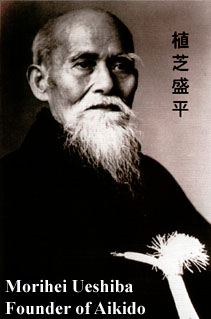
Aikido is a Japanese martial art founded by Morihei Ueshiba (1883–1969). The Japanese government officially recognized aikido in 1940, and American martial arts actor Steven Seagal later helped popularize it in his movies.
Ueshiba, known as O Sensei (great teacher), founded aikido as a departure from the military-style martial arts practiced by the samurai, such as jujutsu. His quest for harmony rather than the defeat of an opponent led him to develop aikido. He established the Aikikai Hombu Dojo in 1927. It still exists as the aikido world headquarters for the Aikikai Foundation, the parent organization for aikido clubs around the world, which preserves Ueshiba's ideals while promoting the art.
After his death in 1969, Ueshiba's son, Kisshomaru Ueshiba, became aikido doshu (headmaster) of the Aikikai Foundation, its highest authority. Kisshomaru Ueshiba Doshu was succeeded in 1999 by his son and O Sensei's grandson, Moriteru Ueshiba Doshu, who continues to spread the art throughout the world.
Aikido comes to America
Aikido's growth in the United States began in the 1960s, when a group of aikido shihan (master teachers) left Japan to teach the art they had learned from O Sensei. They became the pioneers of its international growth.
- Yoshimitsu Yamada
- New York Aikikai; chief instructor and technical advisor of the U.S. Aikido Federation
- Akira Tohei
- 1929–1999; founded Midwest Aikido Center in Chicago
- T.K. Chiba
- 1940–2015; founded Birankai North America
- Mitsunari Kanai
- 1938–2004; founded New England Aikikai in Cambridge, Massachusetts
- Seiichi Sugano
- 1930–2010; New York Aikikai
- Yukio Kawahara
- Vancouver Aikikai
- Yutaka Kurita
- Kurita Juku Aiki in Mexico City
- Ichiro Shibata
- Berkeley Aikikai
- Nobuyoshi Tamura
- Europe
Sources: AikidoSphere, the Aikikai Foundation and the U.S. Aikido Federation.